The Window Never Lies: How to Read a Charity Shop Display Like a Seasoned Hunter
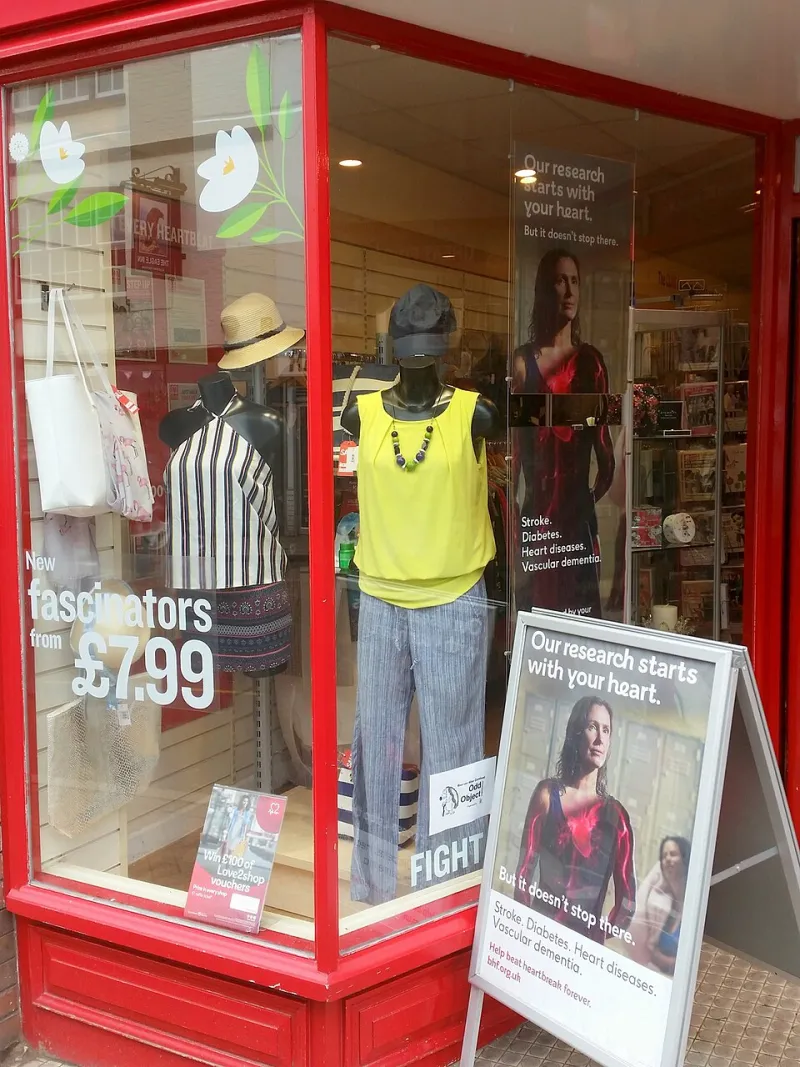
Photo: Jonathan Billinger , CC BY-SA 2.0, via Wikimedia Commons
Every charity shop window is a small autobiography of a street. Somebody's nan's dinner service on the left, a scuffed skateboard in the middle, a single lemon-coloured bridesmaid dress on a mannequin that appears to be screaming. Taken together, it's not clutter. It's a document. And like any document, it rewards a careful reader.
So let's learn to read it.
The thirty-second scan
Before you go in, stand back. Not right up against the glass — that's a rookie move that makes the volunteers nervous and leaves nose prints. Stand on the pavement, hands in pockets, and read left to right.
Look for the three things that matter: quantity, quality and honesty. Is the window crammed to the point of structural concern, or sparse and curated? Crammed usually means a high turnover and a decent chance of something odd. Curated often means a manager with an eye and slightly keener prices. Are the good things front and centre, or is everything behind a rack of DVDs nobody has wanted since 2009?
And honesty: does the labelling look like it was written by someone who cares, or by someone who has given up and written "£2" on a cereal box?
Decoding the handwritten label
The biro tag is where the truth lives. A rough glossary:
- "Vintage" — old. That's all it means. A 2011 high-street denim jacket is, technically, vintage. So is a 1998 Take That tour T-shirt, and that one genuinely is worth the fiver.
- "Unworn" — donated with the tags still on, which tells you someone bought it and then had a long think about their life.
- "Sold as seen" — sold as seen.
- "Complete" — a bold claim in biro that has never once been independently verified by anyone.
- "Retro" — brown.
- "Small mark" — there is a mark, and it is not small.
- "Bargain!" — somebody on the rota has taken against it.
If a tag is suspiciously long, read the whole thing. There is usually a reason for the length.
The jigsaw problem
Let's be clear about the jigsaw. It is the great lottery of the charity shop window, and the odds are not in your favour.
The box may say "complete" in biro. The box may even say "COMPLETE!!" in shouty capitals. This means nothing. It means a volunteer gave it a shake and heard something rattle. Corner pieces prove nothing. Edge pieces prove nothing. The only reliable test is memory, patience and emptying it onto the table at home, by which point the shop has long since closed.
A practical rule: if the box has been taped shut, assume loss. If a photo of the finished picture is missing, assume loss. If it's a 1,000-piece coastal scene in the classic style, assume a piece went under a sofa in 2014 and is now part of another family's life. Buy it for the picture on the lid and the hour of peace it buys you, and you'll never be disappointed.
What's genuinely worth grabbing
Wooden picture frames and mirrors. Sturdy knitwear that hasn't been shrunk. Pyrex and old stoneware. Sewing patterns, even the mad ones. Tools, especially anything with a wooden handle. Sheet music. Children's books in hardback. Cast-iron anything. And the good crockery, which is reliably the best value in Britain.
Equally, most of what's in the window will not change your life, and that is the point. You're not rescuing it. You're choosing it.
A light-hearted taxonomy of the window
The Aspirational Mannequin. Dressed for an event that does not exist in this postcode. Sequinned blazer, no trousers, one earring.
The Single Ski. Never a pair. There is a second shop, somewhere, with the other one. Neither shop knows about the other.
The Jigsaw of Schrödinger. Simultaneously complete and incomplete until opened. Do not ask the volunteer. They don't know either.
The Book With A Dedication. "To Janet, Christmas 1994, with all my love." Ninety-nine pence. Janet was not sentimental. We are.
The Unidentified Kitchen Object. Probably for coring something. Possibly for opening paint. £1.50.
The Wedding Hat. £4. Worn once, in 1994, at a do in a hotel in Solihull. Now, inexplicably, yours.
The Lemon Bridesmaid Dress. Size 8. There is always one. Its owner has been waiting thirty years for this moment.
The VHS Exercise Tape. Still in the shrink wrap. Somebody's New Year resolution, preserved in amber for future generations to study.
The Dinner Service, Seven of Eight. The eighth plate went off to university and never settled back home.
How to buy without building a second hoard
The charity shop is a wonderfully cheap way to acquire clutter at pace. Two questions before the till: Would I pay £15 for this new? and Would I regret it if it was gone tomorrow? If you can only answer one, put it down. Go round the block. If it's still on your mind, it'll still be there — and if it isn't, it was never yours.
Donating without creating a problem
Donate as though you were giving it to a friend, not as though you were throwing it away with extra steps.
- Wash it first. Always. Nobody is paid enough for the alternative.
- Check the pockets. Twice. Nobody wants to find your passport, and nobody wants to have to find you.
- Donate only what you would accept. Broken electricals and incomplete sets are a cost to the shop, not a gift.
- Never leave bin bags outside after closing. A bag on the step at 9pm is not a donation; it's a problem that someone has to deal with in the rain.
- Ask about Gift Aid. If you're a UK taxpayer it's a simple form, and it makes a genuine difference to what the charity can claim.
- Time it around the season. Kitchenware in January, coats in October, everything else whenever — but never on a Saturday morning when the shop is already chocka.
The real reason to look twice
That window is a neighbourhood talking to itself. It's how you learn that someone locally still repairs lawnmowers, that the library fundraiser is on Saturday, that the woman on the rota makes the best lemon drizzle in the county and it's gone by eleven.
So look properly. Buy the £4 hat. Leave the jigsaw on the shelf — honestly, leave it — and say yes to the raffle ticket. You'll come out with a barometer, a paperback and no regrets, which is more than can be said for most shops on the high street.