The Ladder Has a Waiting List: How to Run a Street Tool Table Without Losing Friends

Photo: William Avery, CC BY-SA 2.5, via Wikimedia Commons
There is a moment, usually on a grey Saturday in November, when you realise the job cannot wait. The gutter is overflowing, the curtain rail is wonky, or the shed door has swollen shut. You need a ladder, a drill bit, or possibly a wallpaper stripper. And then, before you can open a browser tab, someone says the words that keep streets running: “Ask next door. He’s got one.”
This is the borrowed ladder economy. It has no app, no membership card and no terms and conditions. It runs on doorbells, garden fences and the cheerful vagueness of “bring it back whenever”. It is also one of the most useful things a street has — and this winter, it might be worth giving it a slightly more formal home.
The network is already there
No one invented the neighbourhood lending network. It grew. Somewhere along the road there is a household with three ladders, a person who owns every drill bit known to mankind, and a retired neighbour whose garage contains a wallpaper steamer, two extension leads and a mysterious tin of hinges. Most of us borrow from them. Most of us lend in return, even if our contribution is a stepladder and a very specific screwdriver.
The problem is memory. Who has the hedge trimmer? When was it promised back? Was that the drill with the dodgy chuck? A monthly tool table does not replace this goodwill. It simply gives it a time and a place — say, the second Saturday of the month, 10am to noon, in the village hall or community centre.
Why a table beats a spreadsheet
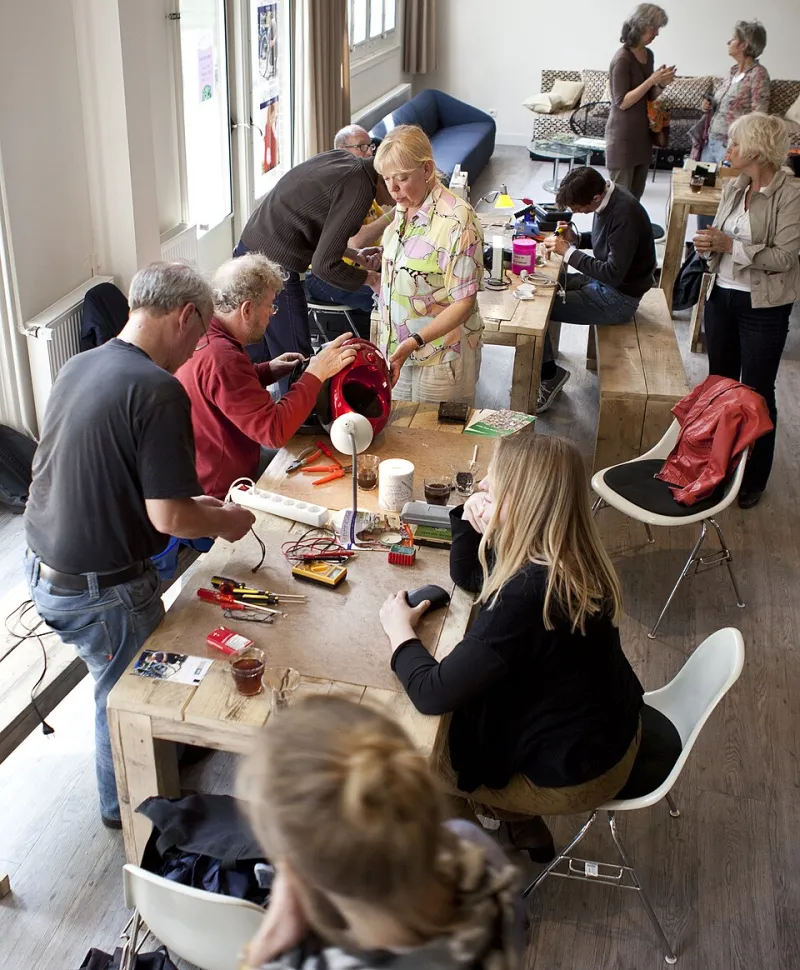
A street WhatsApp group can organise many things, but it is not an inventory system. Messages vanish under bin-day reminders and photographs of lost cats. A tool table works because it is visible. People bring what they are happy to lend, label it, and take it home again. Borrowers turn up, ask, write their name in a notebook, and leave with a drill and a vague sense of responsibility.
It also lowers the awkwardness. Asking to borrow a ladder from a neighbour can feel like asking for a favour. Asking at a tool table feels like using a service. That small shift makes a difference, especially for people who are new to the area or who would rather not knock on a stranger’s door.
The etiquette of the handover
The golden rule is simple: return it as you would want to receive it. That means clean, dry and complete. A hedge trimmer returned with last summer’s clippings stuck to the blade is not a loan; it is a test of friendship. A drill returned without its charger is a puzzle nobody asked for.
Be clear about the basics before the item leaves the table. Does it need a particular battery? Is the guard missing? Is the ladder rated for anything heavier than a string of fairy lights? A little honesty at the handover saves a lot of muttering later. And if you are the borrower, do not lend the borrowed item onwards. The chain of custody is fragile enough without a neighbour-of-a-neighbour entering the picture.
Safety checks with a clipboard and common sense
A tool table is not a professional tool-hire shop, and it should not pretend to be. But a few basic checks are worth doing. Look at plugs and leads for fraying. Check that guards are present. Make sure ladders are not cracked, bent or missing feet. If an item looks tired, it can still be useful — but it should be labelled clearly, perhaps as “spare parts only” or “not for heavy jobs”.
Power tools should come with their instructions if possible. Petrol tools should not be run indoors, and anything with a blade should be handed over with the blade covered. It sounds po-faced, but a two-minute check at the table is easier than a difficult conversation after an accident. A local repair café or men’s shed may be happy to help with basic checks, and some councils offer advice on running community equipment schemes.
The insurance question
This is the bit where enthusiasm meets paperwork. Household insurance generally covers your own belongings, not a community lending scheme. If you are running a tool table through a village hall or community centre, ask about public liability cover and whether the event fits the building’s insurance. The parish council may have a view. A community group may already have a policy.
Do not assume a handwritten sign saying “at your own risk” solves everything. It does not. The sensible approach is to keep the scheme small, informal and transparent: record what is lent, check items before they go out, and make sure everyone understands that tools are borrowed for personal use. If the table grows beyond a few neighbours, it is worth taking proper advice rather than relying on a hopeful shrug.
The delicate politics of the return
Every street has a hedge trimmer story. Sometimes the trimmer comes back in September. Sometimes it comes back in March, with a new scratch and a vague explanation about a hedge that “got away from us”. The tool table cannot eliminate this, but it can soften it.
Set a return date and write it down. Not a vague “next week” — an actual date. A fortnight is usually plenty for a small job. If the borrower needs longer, they should say so before the date passes. Most people are reasonable. They simply forget. A friendly note in the notebook is better than a cold stare over the fence.
And if you are the lender, label your things. A strip of tape with your house number is enough. It prevents the classic village hall mix-up in which three identical drills go home with the wrong people and everyone spends a week being politely confused.
How to start one
Pick a date and a room. Ask the village hall if you can use a corner for an hour. Put a notice on the parish board and in the street WhatsApp group. Invite people to bring one or two things they are happy to lend — not their prize possessions, just the useful spares. Bring a notebook, a pen, some cable ties and a roll of masking tape. Make tea. That is most of the job.
The first table may be small: a stepladder, two drills, a wallpaper stripper and a very earnest conversation about hedge trimmers. That is fine. The point is not to build a warehouse. The point is to make the existing kindness a little easier to find. By the time the next gutter overflows, someone will know exactly whose ladder is free — and exactly when it is coming back.